

Precision Lifting Tools for Industrial Warehouses & Heavy Platforms

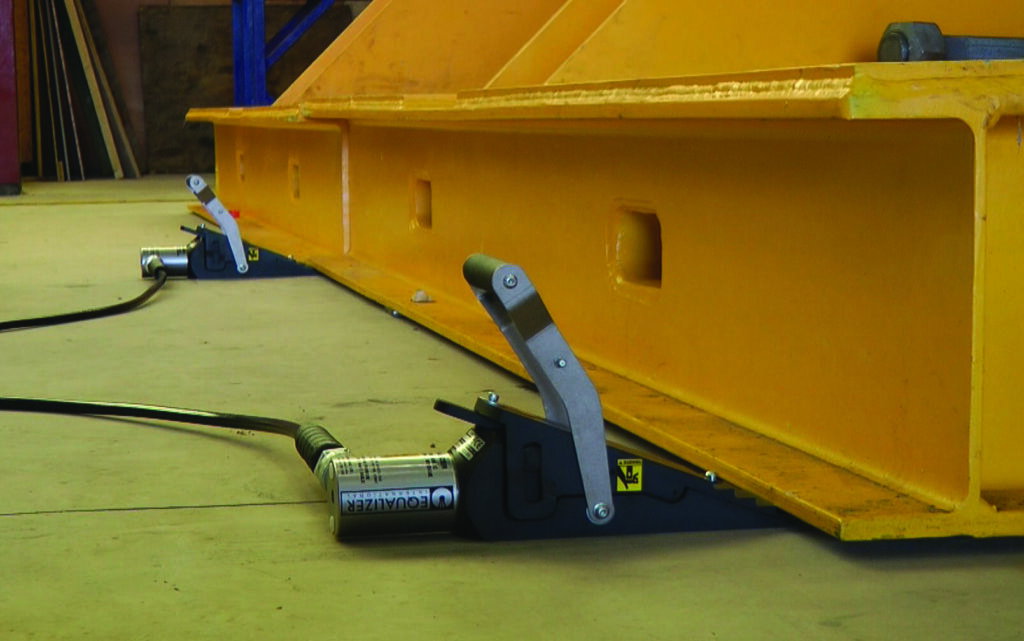
Impact of the Step Wedge Design in Lifting Heavy-Duty Equipment
The Precision Lifting Tool, featuring a step wedge design, is engineered to safely and progressively elevate heavy platforms or equipment in areas where clearance is too limited for forklift tines. Its low‑profile geometry allows insertion into tight gaps, enabling controlled lift without the need for conventional lifting machinery.
How It Works
- Progressive Lift Control: The stepped wedge profile provides incremental lifting, giving operators precise control over elevation without sudden shifts or instability.
- Low‑Profile Insertion: The tapered leading edge enables easy placement between objects or under components with minimal clearance.
- Load Distribution: The wide base and stepped geometry distribute force evenly, reducing the risk of flange damage or misalignment.
- Safety Features: Anti‑slip surfaces and mechanical stops prevent over‑extension or slippage under load.
Operator Benefits
- Hands‑Free Elevation: Minimizes the need for crowbars, prying, or manual lifting—reducing pinch‑point hazards and ergonomic strain.
- Compact & Portable: Lightweight design allows easy transport and use in confined or elevated workspaces.
- Compatible with Fit‑Up Tools: Often used in conjunction with forklifts for added versatility.
Precision Lifting Tools vs. Overhead Cranes
Overhead crane systems represent a significant investment, with costs ranging from $10,000 for small-capacity models to well over $100,000 for larger, heavy-duty installations. According to Kino Cranes, single girder overhead cranes suitable for lighter loads can start around $10,000–$25,000, while mid-range systems with capacities up to 20 tons often fall in the $50,000–$100,000 bracket. Double girder cranes, designed for heavier and more complex lifting requirements, can quickly exceed this range, with prices climbing into the hundreds of thousands of dollars depending on span, lifting height, and added features.
Precision Lifting Tools vs. Overhead Crane Systems
Precision Lifting Tools, the emphasis is on compact, specialized lifting solutions that enhance safety and efficiency in industrial environments. These tools are engineered to handle demanding lifting tasks without the massive infrastructure or cost associated with overhead crane systems. While overhead cranes are indispensable for large-scale operations, their price tag of $10,000–$100,000 and beyond makes them a major capital expenditure. By contrast, precision lifting tools offer a more accessible, flexible option for companies that need reliable lifting capability without the overhead of installing a permanent crane system.
Cost Considerations for Industrial Operations
The Kino Cranes pricing guide highlights how capacity, span, and design complexity drive crane costs. For example, a single girder crane under 5 tons may be relatively affordable, but as soon as lifting requirements increase to 20–50 tons, prices escalate to $100,000–$200,000. Double girder cranes, which provide greater stability and load capacity, can range from $200,000–$500,000 or more. This makes overhead cranes a long-term investment requiring careful planning, installation, and ongoing maintenance.
Why Precision Lifting Tools Matter
For many warehouses and industrial sites, investing in precision lifting tools is a practical alternative. They deliver 19 tons (38 tons if used in pairs) of lifting force per tool in a safer, more controlled lifting at a fraction of the cost of overhead crane systems. By integrating these tools into daily operations, companies can reduce risk, improve worker safety, and avoid the steep financial commitment of installing a crane system. This balance between affordability and performance is why precision lifting tools are increasingly seen as essential equipment for modern, safety-conscious warehouses.
Summary
Overhead crane systems can cost anywhere from $10,000 to well over $100,000, with advanced double girder models reaching $200,000–$500,000. Precision lifting tools provide a cost-effective, safety-focused alternative for warehouses that want reliable lifting solutions without the heavy financial burden.