

There are three main types of flange spreaders — force wedge, step wedge, and grip-style. A flange spreader separates two flange faces a controlled, measured amount — enough to pull a gasket, remove a valve, or pressure-test a joint — without the face damage, sudden ejection, or lost time that come from prying a joint apart with a pry bar or driven wedge. Which tool fits a given job depends mainly on one variable: how much gap is available between the faces to begin with.
The problem with pry bars and driven wedges
Before purpose-built spreading tools, the standard approach was a driven wedge (sometimes called a “banana wedge”) or a pry bar, worked in by hand or with a hammer. Both carry the same core risk: the wedge or bar can eject under load, sending a piece of metal through the air toward whoever is working the joint. Pry bars can also break suddenly under load. Beyond the immediate injury risk, hammering on the faces themselves can damage the sealing surface — a problem that often doesn’t show up until the joint is reassembled and starts to leak.
There’s also a time cost that’s harder to see up front. Once a joint is loosened, misalignment and stuck bolts are close to guaranteed, and how bad it will be is unpredictable. A stuck joint on the critical path can pull in a rigging team, a crane, and additional safety permits — resources that weren’t planned for when the job was scoped.
Three Types of Flange Spreaders
The three types of flange spreaders are generally selected by the size of the gap at the face, not by flange size alone:
Force wedge. For flanges with little to no existing gap (as little as 1/16 inch), a self-contained force wedge — rated to 15,000 lbf — is driven in mechanically. A holding-bar arrangement keeps the tool secured to the flange so it can’t be ejected under load, addressing the failure mode of a traditional driven wedge directly.
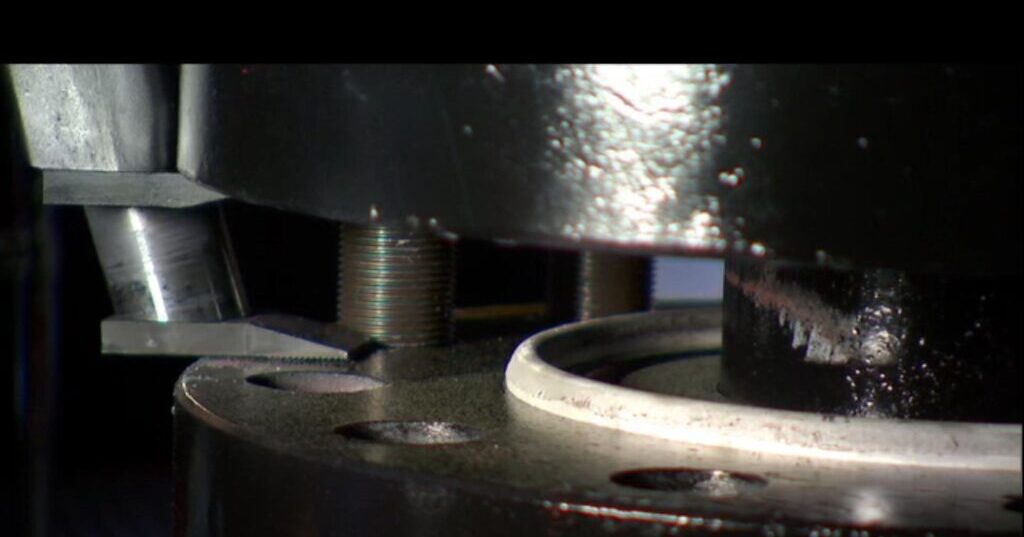
ESI Mini Gap Flange Spreader
Step wedge. For gaps of roughly 1/4 inch or more, a step wedge uses interlocking segments that expand as the tool is inserted further. The engineering redirects the spreading force to run parallel to the pipe rather than back toward the operator, and if the tool does fail, it’s designed to drop rather than eject — a lanyard catches it. These tools are typically supplied as a kit (two spreaders, pump, hoses, and step/safety blocks) so a job can spread a joint from two points at once, which is the configuration used for valve removal (see below). ESI rents this tool as the Mechanical Step Wedge Flange Spreader.
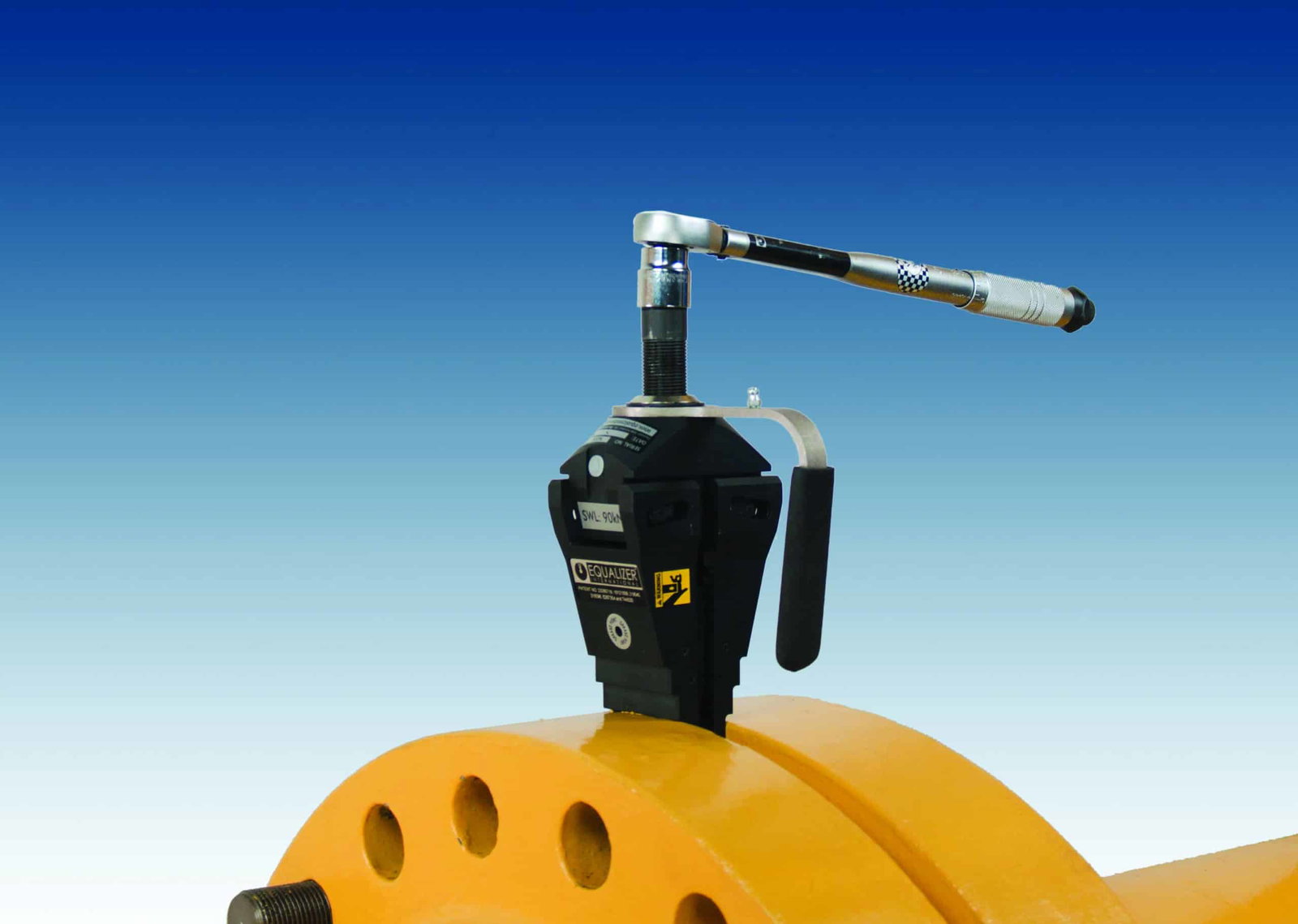
ESI Mechanical Step Wedge Flange Spreader
Grip-style (collet) tools. For flanges with essentially zero gap — including compact-flange designs where no foreign object can sit on the sealing face — a different mechanism is used: an arm on each side of the joint is inserted into the bolt hole, where a set of collets expands against the hole’s inner wall as the tool is actuated, gripping the flange from the inside rather than pushing from the outside.
Because nothing sits between the faces, this approach gives full, unobstructed access to the gap — useful for pulling a blind or a valve. Mechanical versions run 4, 6, and 11 tons; hydraulic versions run 13 and 15 tons, with additional 18- and 25-ton hydraulic variants for harder-to-reach applications. This is the same product line ESI rents for valve removal.

ESI SG Collet Flange Spreader (grip-style)
Case example: valve removal time
On one job, ESI used four 15-ton grip-style tools to remove and replace an ANSI 300 butterfly valve — four tools were used because the required force wasn’t known in advance, not because four tools are standard for this job size. The job, start to finish, had previously represented a 30-hour commitment of time and resources. With the tools, it was completed in under 6 hours, with fewer people involved and a better safety profile.
Why this matters for maintenance and turnaround planning
Time lost on a stuck or misaligned joint doesn’t stay contained to that one task. It pulls in rigging, cranes, and permit delays that weren’t part of the original plan — and on a turnaround, where many tasks are already layered on top of each other, that kind of overrun compounds. Tools that let a crew separate a joint in a controlled, predictable way, rather than relying on a driven wedge to hold, remove one of the more unpredictable variables in the schedule.
ESI rents all types of flange spreaders described here — see Flange Spreader Rentals for current availability.